



DENVER — A $5.5 billion upgrade to the Global Positioning System moved a step closer to launch this week when a prototype arrived at a Lockheed Martin complex in Colorado to begin months of tests.
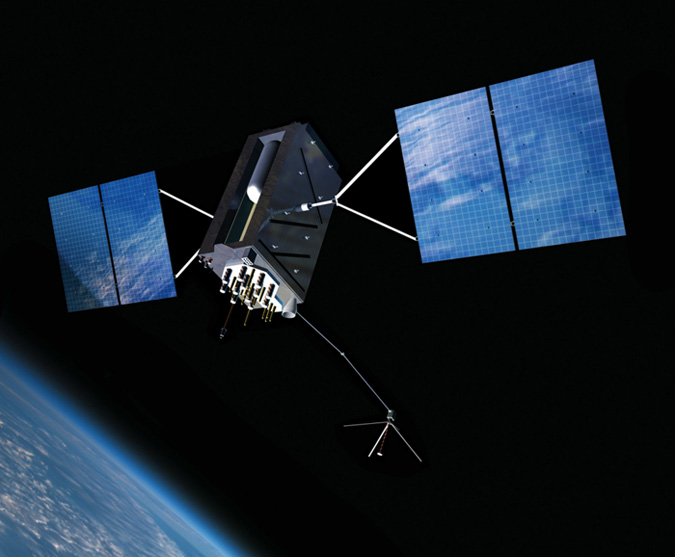
It’s the guinea pig for a new generation of GPS satellites, called Block III, that’s expected to make military and civilian receivers more accurate, powerful and reliable.
Videos


Additional Photos
They’re also part of an international effort to allow civilian receivers to use signals from U.S., European, Russian and perhaps other satellite navigation systems.
GPS has become ubiquitous in American civilian and military life, with hundreds of thousands of receivers in cars and weapons systems. Financial systems use GPS receivers to get precise time stamps for transactions, relying on the atomic clocks onboard the satellites.
The Air Force Space Command oversees the United States’ GPS satellites and ground control systems from its headquarters at Peterson Air Force Base, Colorado.
The Block III satellites are expected to allow military and civilian users to determine their position within 3 feet, compared with 10 feet with current technology, according to the Congressional Budget Office.
Higher-powered signals from Block III satellites are expected to be harder for enemies to jam and easier for receivers to tune in, especially in urban canyons or under thick tree canopies.
The U.S. and other countries have agreed to make a new, common frequency available to civilians. That means civilian receivers could calculate their position from a number of different satellite navigation systems.
The Block III prototype arrived Monday at an $80 million test facility at Lockheed Martin’s Waterton Canyon complex south of Denver. Workers will do final assembly work on the prototype in a cavernous clean room and then run it through a gantlet of tests.
The prototype won’t be launched into space. The first flight model is expected to arrive at Waterton Canyon next year and be launched in May 2014.
Flying versions of the satellite will go through final assembly in the same room where the prototype is assembled and tested. They’ll also be subjected to extreme temperatures that mimic conditions in space.
Lockheed Martin, based in Bethesda, Maryland, has a $1.5 billion Air Force contract to build and test the GPS III prototype and build the first two satellites for launch. The contract includes an option for 10 more.
The company expects the Air Force to authorize construction to begin on the third and fourth flight satellites later this month.
The Pentagon expects to buy and launch a total of 32 Block III satellites. The Air Force says it will cost about $5.5 billion to design, build and launch all the satellites and upgrade the ground control systems.
The number of planned satellites helps reduce costs, said Keoki Jackson, Lockheed Martin program director for GPS III.
“GPS is unlike most space programs,” he said. “The Air Force gets the advantage of mass procurement.”
Other savings are expected from the satellite’s design, which can accommodate technology updates with few physical changes, and from its planned operating life — 15 years compared with seven to 12 years for most military satellites — Jackson said.___
Copy the Story LinkSend questions/comments to the editors.

Success. Please wait for the page to reload. If the page does not reload within 5 seconds, please refresh the page.
Enter your email and password to access comments.
Hi, to comment on stories you must . This profile is in addition to your subscription and website login.
Already have a commenting profile? .
Invalid username/password.
Please check your email to confirm and complete your registration.
Only subscribers are eligible to post comments. Please subscribe or login first for digital access. Here’s why.
Use the form below to reset your password. When you've submitted your account email, we will send an email with a reset code.