




SKOWHEGAN — On a recent Thursday afternoon, fourth-grade students at Bloomfield Elementary School examined owl skulls and the webbed feet of a loon. They made drawings of birds and searched for bones in owl pellets.
They also practiced their writing by taking notes for a journal entry.
Additional Photos
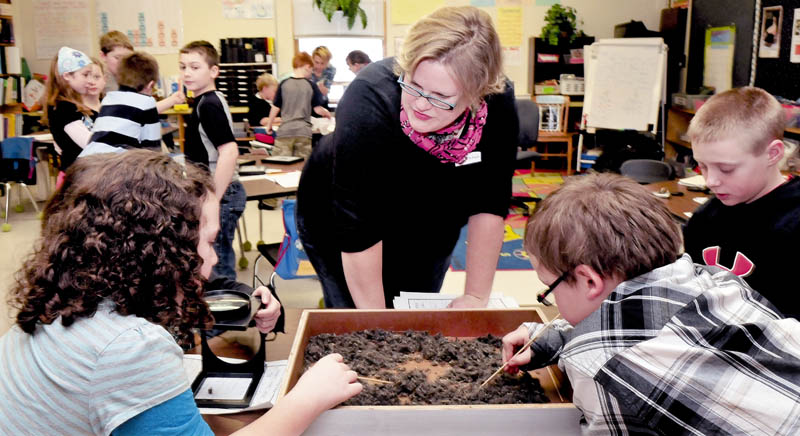
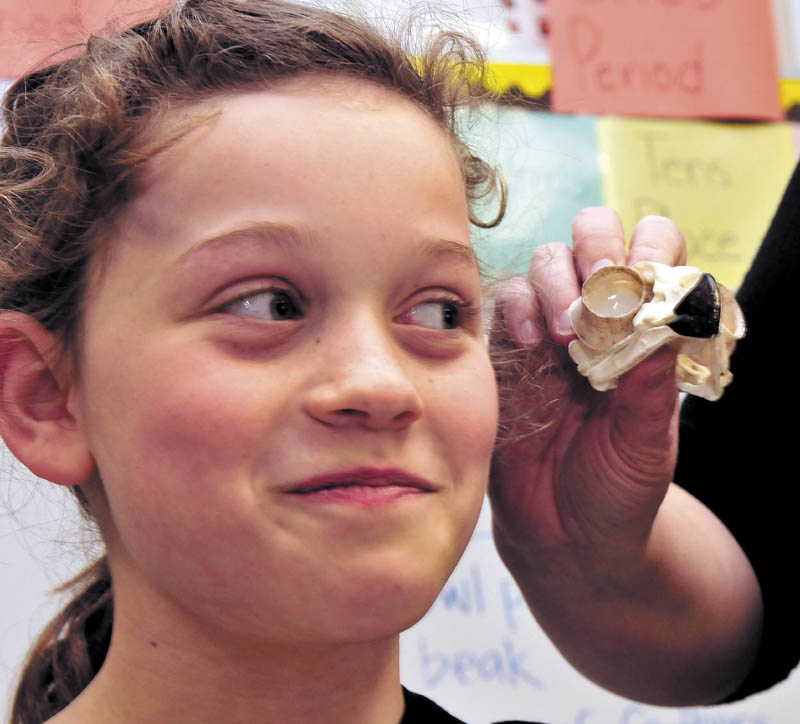
The activities are part of a series of weekly visits from the L.C. Bates Museum in Fairfield. The museum runs an educational outreach program that takes exhibits to schools, helping them save on transportation costs while still giving children an opportunity to explore beyond the classroom.
The Bloomfield fourth-grade classroom is one of about 106 in the area to incorporate the growing program into their curriculum. Once a week the class welcomes Serena Sanborn, one of three teachers at the museum, who brings a different exhibit from the museum’s natural science collection.
“The number of field trips we can take is limited, so it’s a more economical and acceptable solution to get kids access to things we don’t have,” said their teacher, Peter Hockmeyer.
“A lot of schools don’t have money for field trips, so this is a way of bringing the museum to the school,” said Deborah Staber, the museum’s director. “It doesn’t cost the museum anything because it’s funded with grant money, and the schools don’t have to pay for busing. It’s a win-win,” she said.
The program started in 2006 with one part-time teacher going to five or six classrooms, Staber said. Last year it reached about 60 or 70 classrooms. Since then, it has grown to reach 106 classrooms in 17 schools and 10 pre-schools this year, she said.
Staber said demand has grown at the same time the museum has seen fewer school field trips coming to it.
“There is definitely a need. Fewer schools are providing busing to come to the museum, and that is true across the country. There’s just a huge drop in the number of field trips everywhere,” she said.
Realizing that need was one of the reasons the museum started its educator program, which is funded by grants from a variety of sources, Staber said. Some of the money comes form the national Institute of Museums and Library Services. Some comes from local donors such as Skowhegan Savings Bank, Franklin Savings Bank and the Plum Creek Timber Co.
Rising costs, tighter budgets
Brent Colbry, superintendent for Skowhegan-based School Administrative District 54, where the Bloomfield school is located, said there have been fewer field trips in the district in recent years because of concerns about lost instructional time and lack of revenue.
“The loss of instructional time was really quite a concern when we were going on more field trips,” Colbry said. The district also has less money because of state funding cuts and money following some students to charter schools, he said.
Colbry said he anticipates a tight budget in the upcoming school year, and the district is determining the financial effect of Gov. Paul LePage’s proposed cuts to education funding.
“Because of our lack of revenue, we have had to reduce spending wherever we can. Transportation is really a focal point of that,” he said.
Each grade is allowed to go on two field trips within the district each year, he said.
Fitting museum visits into curriculum
The Bloomfield fourth-graders haven’t gone on any science-related field trips this year, Hockmeyer said, and the museum program is a way of letting them explore things in nature that they might not see otherwise.
Because of scheduling limitations, Sanborn comes to the class during their language arts period, so Hockmeyer said he has incorporated writing into the visit. Students take notes during the visit so they can write journal entries later on.
In the fourth-grade curriculum, Hockmeyer said he covers three major science topics: land and water, motion and space, and ecosystems. The program provides access in the way a traditional field trip would, he said.
“There are things we touch on, but can’t explore to the same breadth or width,” he said. “The kids love it.”
Sanborn visits classrooms at the pre-kindergarten, second- and fourth-grade levels.
She spends about an hour a week in each classroom. The programs typically run eight to 10 weeks.
“So many kids don’t know the species that live in their own backyard. You would be surprised in our area how many haven’t even seen the ocean. I love seeing them interact with real things,” she said.
The program focuses on Maine’s natural history with each week organized around a different topic. Themes of the current program include Maine habitats, animal groups, rocks and minerals, and trees and plants.
The birds lesson the Bloomfield students recently engaged in fell under animal groups, which also might include visits about insects, reptiles or endangered species.
Feedback from students
At Bloomfield Elementary, Sanborn gave an interactive talk for about half the period. Then the children helped her set up exploratory stations around the classroom.
“We get to observe stuff she brings in like skulls,” said Kylee Braley, 10, of Skowhegan, as she worked on making a drawing of a bird using a stamp and crayons.
“We can make stuff, and there’s not as much talking as usual,” said Marlee Hisler, 10, of Skowhegan.
At a nearby table, other students used sticks to poke through a container of owl pellets that had been sterilized.
A classmate, Elizabeth Steeves, 9, of Skowhegan agreed. “This is a treat,” she said. “I’m really happy to learn.”
Limits to traveling museum
Not everything at the museum is suitable for life on the road.
The museum takes some things from its regular collection, but mostly keeps separate educational materials reserved for trips to the schools.
“It’s pretty hard on the objects, bringing them out on bumpy roads and into classrooms,” Sanborn said.
She still hopes children will visit the museum with their families to see the things they won’t see in school.
As part of the program, the museum offers four family days with free admission to students and their parents. The family days have themes that relate back to the lessons in the classroom and often include outdoor activities including exploring the pond at the museum’s campus.
“The idea is to still get them here, but get their parents to bring them,” Staber said.
Rachel Ohm — 612-2368
rohm@mainetoday.com
Send questions/comments to the editors.

Success. Please wait for the page to reload. If the page does not reload within 5 seconds, please refresh the page.
Enter your email and password to access comments.
Hi, to comment on stories you must . This profile is in addition to your subscription and website login.
Already have a commenting profile? .
Invalid username/password.
Please check your email to confirm and complete your registration.
Only subscribers are eligible to post comments. Please subscribe or login first for digital access. Here’s why.
Use the form below to reset your password. When you've submitted your account email, we will send an email with a reset code.