



AUGUSTA — Gov. Paul LePage proposed a $6.2 billion, two-year state budget Friday that would make deep cuts to human services and suspend revenue sharing for cities and towns while protecting tax cuts passed by the last Legislature.
Opponents’ response to the proposal was swift. Democrats said the governor is proposing a massive tax shift to municipalities, which would have to choose between raising property taxes and cutting services and local funding to schools.
Additional Photos



But the Republicans’ leader in the House, Ken Fredette of Newport, said, “This budget gives us a blueprint for a right-sized government.”
In a prepared statement, Fredette, said, “It sets us in the right direction by keeping the tax burden on Maine families low while paying our bills and reforming our overly generous welfare system.”
The proposed budget for the two years starting July 1 would save more than $52 million by eliminating or tightening eligibility for services for low-income residents.
It also would eliminate more than 200 positions in state government.
The suspension of municipal revenue sharing would save the state close to $200 million over two years. But the proposal may be a non-starter for lawmakers who would have to defend it in their home districts, where local officials could be forced to raise property taxes to cover the loss in state funding.
The Republican governor’s previous attempt to decrease revenue sharing, in 2011, was rejected by a Republican-led Legislature.
LePage said in a prepared statement Friday that state government has to learn how to manage its finances, and so do municipal governments.
Portland Mayor Michael Brennan said he doubts that the revenue sharing proposal will survive because it would hit every city and town in Maine.
Brennan, who served in the Legislature for 13 years, said there has “never been anything as radical and far-reaching as this proposal.”
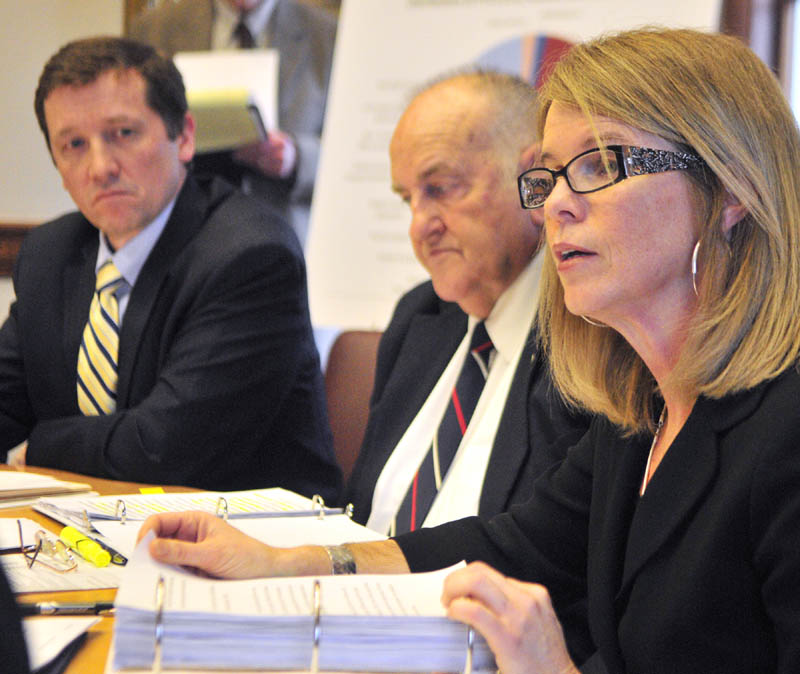
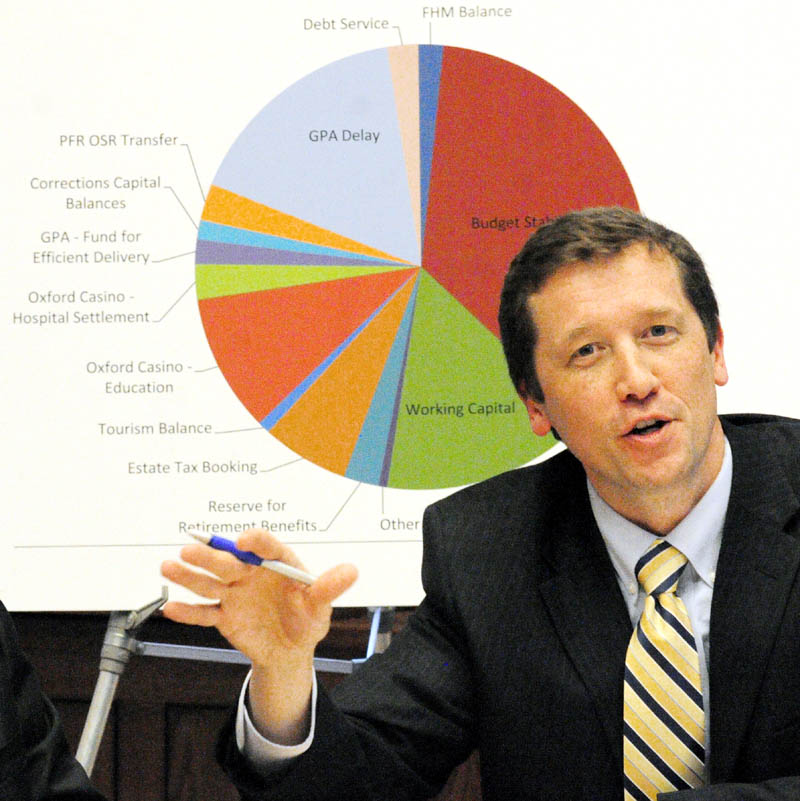
Sawin Millett, LePage’s budget officer, acknowledged that the revenue-sharing freeze is a bold proposal.
Millett, who presented the budget to legislators on LePage’s behalf, said it was one of the most difficult spending plans he had ever drafted.
He said that as it looks to cut costs, the state is out of “low-hanging fruit.” All that remains are structural reforms.
“We couldn’t pull the strings together and balance this budget with easy fixes,” he said.
Democrats countered that suspending revenue sharing, along with several other initiatives that cut state aid to towns, effectively would be a tax shift of about $400 million.
Included in that calculation is a $73.4 million cut to the circuit breaker property-tax relief program. LePage has proposed eliminating the program, as well as the homestead property-tax exemption, for everyone younger than 65.
The budget would also reduce state expenditures on teachers’ retirement by $28 million by making school districts contribute to the cost, which is now covered wholly by the state. The state would contribute $14 million toward retirement costs.
Lois Kilby-Chesley, president of the Maine Education Association, called the budget proposal “a giant shell game” that would hurt public schools and teachers.
“Ultimately, when we impact the schools, we impact the children of Maine,” she said. “This is a very sad day for our students. A shift in educator retirement cost to the local communities is a prime example of that shell game.”
The budget also would cut nearly $52 million in welfare programs, including the elimination of the state’s drug care program for the elderly.
Despite deep cuts in welfare programs, the budget would increase funding for mental health services by $2 million.
Health and Human Services Commissioner Mary Mayhew said the administration understands the impact of the human services cuts but they are necessary to sustain the programs.
Democrats weren’t buying it.
“These are the governor’s priorities,” said Senate President Justin Alfond, D-Portland. “These are his values. This is one of the biggest tax increases the state has seen in a very long time and it’s shifted to our municipalities, on our businesses, on poor people and the middle class. We don’t think that’s the way to build the economy.”
LePage said the budget reflects a crisis caused by out-of-control welfare growth and previous state spending.
“These are challenging and difficult times,” LePage said in a statement. “Our state is facing an economic crisis, and we need to examine our spending practices, evaluate our delivery of services and gain control of our welfare system.”
LePage said in his statement that the suspension of revenue sharing “is a reflection of growth in welfare in Maine.”
Democrats and advocacy groups for low-income residents noted that funding for MaineCare has been mostly flat since 2006. MaineCare is the state’s version of Medicaid, a federal and state program that provides health care coverage to low-income and older residents.
MaineCare caseloads have increased since 2002, but advocates say the growth is linked to the recession and to enrolling nearly 20,000 seniors and people with disabilities who receive help with prescription drugs — programs that receive federal matching funds.
Sara Gagne Holmes, executive director of Maine Equal Justice Partners, an advocacy group for low-income Mainers, said the cuts would affect more than the poor and elderly.
“The governor and the administration have made choices, and those choices have led to the budget deficit,” she said. “And now he’s using that deficit to justify significant cuts to a majority of Maine people that will result in significant harm.”
The budget would effectively flat-fund education. The governor increased education funding by $63 million in his previous two-year budget, which ends June 30.
Education Commissioner Steve Bowen said General Purpose Aid to schools would stay around $900 million through fiscal years 2013-14 and 2014-15.
The administration would add $16 million in incentives for educational efficiency, to establish accountability and boost the Jobs for Maine’s Graduates Program.
Bowen said he feels lucky to be spared some of the difficult cuts that target other state programs.
Democrats countered that the so-called tax shift to communities would affect education in public school districts.
House Majority Leader Rep. Seth Berry, D-Bowdoinham, said the tax shift is “unacceptable” and nearly equals the cost of the tax cuts enacted in 2011.
The tax cuts received two-thirds support from the Legislature — a point frequently raised by Republicans when Democrats say that the package blew a hole in the next two-year budget.
Democrats say they agreed to the tax cuts at the time to save social services programs.
Democrats campaigned against the tax cuts last fall, saying they primarily benefit wealthy Mainers.
Now in the majority, Democratic lawmakers are under pressure to repeal or delay the cuts for top earners.
The Maine People’s Alliance, a progressive group that helped Democrats win back the Legislature, called the budget “unconscionable” and threatened electoral consequences for Democratic lawmakers who vote for it without repealing the tax cut for wealthy Mainers.
“Governor LePage created a false crisis through his tax breaks for the wealthy and now he’s looking to make the middle class and the poor pay the bill with cuts to health care and local schools,” said Mike Tipping of the Maine People’s Alliance in a statement.
Democrats have dodged direct questions about whether repealing or freezing the tax cuts will be negotiated as part of a budget solution.
Berry, echoing the statements of other Democratic leaders, would say only that “everything is on the table.”
LePage acknowledged that his budget is designed to protect the $400 million tax cut package.
He suspects that the new Democratic majority will try to roll back the reductions during the coming budget debate. LePage’s Republican colleagues have defended the tax cuts on several fronts, saying tax relief is especially important because Congress eliminated a payroll tax cut in its “fiscal cliff” deal.
Sen. Roger Katz, R-Augusta, said he is pleased that the governor didn’t add to the “current heavy tax burden on Maine citizens.”
LePage’s proposal sets the stage for a political debate that will rage over the next several months.
But the real negotiations will take place among lawmakers on the Legislature’s Appropriations Committee. The budget-writing panel will begin reviewing the budget and, most likely, make significant changes.
Democrats have the majority, but their counterproposal will need enough Republican support to override LePage’s veto power.
State House Bureau Writer Michael Shepherd contributed to this report.
State House Bureau Writer Steve Mistler can be contacted at 620-7016 or at:
smistler@pressherald.com
Send questions/comments to the editors.

Success. Please wait for the page to reload. If the page does not reload within 5 seconds, please refresh the page.
Enter your email and password to access comments.
Hi, to comment on stories you must . This profile is in addition to your subscription and website login.
Already have a commenting profile? .
Invalid username/password.
Please check your email to confirm and complete your registration.
Only subscribers are eligible to post comments. Please subscribe or login first for digital access. Here’s why.
Use the form below to reset your password. When you've submitted your account email, we will send an email with a reset code.